
Potatoes are one of the most widely processed agricultural products in the world. While fresh potatoes have limited shelf life and require significant storage and transportation infrastructure, converting them into a dehydrated ingredient creates a more convenient, stable and commercially valuable product.
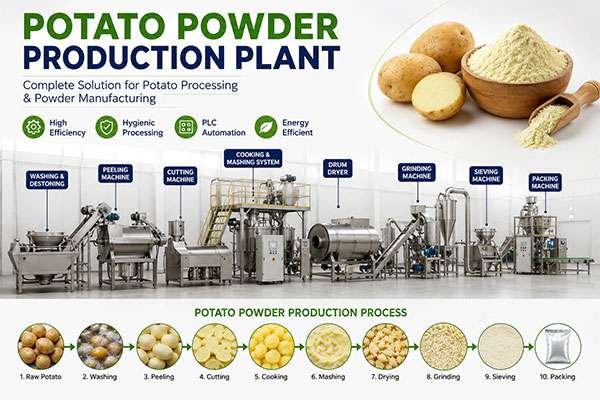
A Potato Powder Production Plant is designed to transform fresh potatoes into finely processed potato powder through a controlled sequence of washing, peeling, cutting, cooking, mashing, drying, grinding, sieving and packaging.
For food manufacturers, snack producers, ingredient suppliers and entrepreneurs planning a new potato-processing facility, the biggest challenge is not simply finding a machine. The real challenge is designing a balanced production system in which raw-material handling, thermal processing, dehydration, powder making and packaging work together efficiently.
This complete guide explains the potato powder production process, machinery requirements, plant configuration, quality factors, capacity considerations, applications, investment factors and important points to consider before establishing a commercial potato powder manufacturing facility.
What Is a Potato Powder Production Plant?
A Potato Powder Production Plant is an integrated food-processing line that converts fresh potatoes into dehydrated and powdered potato products.
A typical industrial process follows this sequence:
Fresh Potato → Washing → Destoning → Sorting → Peeling → Cutting → Blanching/Cooking → Mashing → Drying → Grinding → Sieving → Packaging
The exact process configuration can vary depending on the required product specification.
A commercial plant is generally designed to achieve:
- Consistent product quality
- Controlled moisture content
- Uniform particle size
- Efficient potato utilization
- Continuous material flow
- Hygienic processing
- Reduced manual handling
- Controlled energy consumption
- Reliable production capacity
The important point is that a production plant should be considered as a complete process, not simply a collection of independent machines.
Why Convert Fresh Potatoes Into Powder?
Fresh potatoes are highly useful but contain substantial moisture. This makes them comparatively bulky and more challenging to store and transport for extended periods.
Dehydration changes the economics and handling characteristics of the product.
Potato powder can be:
- Stored more conveniently
- Transported efficiently
- Measured accurately
- Used as a dry food ingredient
- Incorporated into different formulations
- Supplied to food manufacturers throughout the year
This creates an opportunity for processors to move from selling a raw agricultural commodity toward producing a value-added food ingredient.
The transformation is straightforward in concept:
Agricultural Raw Material → Controlled Processing → Dehydration → Powder → Value-Added Ingredient
But achieving consistent results requires careful engineering at every stage.
Potato Powder Manufacturing Process
The performance of a Potato Powder Manufacturing Plant depends on how effectively each stage prepares the product for the next.
Let’s examine the complete process.
1. Raw Potato Receiving
Fresh potatoes are received and inspected before entering the processing line.
Raw-material evaluation may include:
- Potato variety
- Size
- Physical condition
- Soil contamination
- Foreign materials
- Damage
- Rot or deterioration
- Dry-matter characteristics
Raw potatoes with inconsistent quality can create variations throughout the production process.
For commercial production, raw-material selection should therefore be treated as part of the process design rather than an afterthought.
2. Potato Washing and Destoning
Potatoes arriving from agricultural fields commonly contain soil, sand, stones and other foreign materials.
The washing section removes surface contaminants, while destoning equipment separates heavier foreign materials.
This stage performs two important jobs:
First: it prepares the potatoes for hygienic food processing.
Second: it protects downstream machinery from stones and abrasive contaminants.
A properly designed washing system should provide effective cleaning while maintaining practical water consumption and continuous product flow.
3. Potato Sorting
Clean potatoes are transferred to a sorting section.
Damaged, unsuitable or defective potatoes can be separated before further processing.
Sorting improves consistency and prevents unsuitable raw material from unnecessarily occupying processing capacity.
In larger facilities, sorting can be incorporated into a continuous conveyor system.
4. Potato Peeling
After cleaning and sorting, the potatoes are peeled.
The objective is simple:
Remove the skin while preserving as much usable potato material as possible.
This is where machine performance matters.
Excessive peeling can increase raw-material losses, while insufficient peeling can affect final product appearance and quality.
Therefore, the peeling system should be selected according to:
- Potato variety
- Potato size
- Required capacity
- Peeling method
- Product specification
- Expected operating conditions
5. Potato Cutting
Peeled potatoes are cut into controlled sizes before thermal processing.
Uniform cutting is important because it allows more consistent heat penetration during blanching and cooking.
If potato pieces vary significantly in size, the cooking stage may become inconsistent.
A well-designed Potato Powder Production Plant therefore maintains controlled product size before thermal processing.
6. Blanching and Cooking
The prepared potatoes are subjected to blanching and/or cooking according to the selected process technology.
The purpose is to soften the potato and prepare it for mashing and dehydration.
Process conditions such as:
- Temperature
- Residence time
- Feed rate
- Product thickness
- Heating method
must be controlled according to the selected process.
Cooking is not merely a preparation step. It influences the texture of the mash and the behavior of the material during drying.
7. Potato Mashing
Cooked potatoes are converted into a relatively uniform mash.
This mash becomes the feed material for the dehydration stage.
Uniform mash preparation is important because uneven material distribution can contribute to inconsistent drying.
The capacity of the mashing system should therefore be properly matched with both the cooking and drying sections.
8. Drying: The Critical Stage in Potato Powder Production
Drying is one of the most important operations in the entire plant.
The objective is to remove sufficient moisture from the cooked potato material while maintaining the required characteristics of the final product.
For potato-based dehydrated products, drum drying is one established industrial approach. Cooked potato material can be spread onto a heated drum, where moisture is removed and a dried potato sheet is produced before further size reduction.
Other drying technologies may also be considered depending on the desired product, production capacity and process configuration.
9. Dried Potato Breaking
Depending on the selected process, the dried potato material may form sheets, flakes, lumps or other dried structures.
The material is then broken or reduced to a suitable feed size before final milling.
This intermediate stage helps prepare the dried material for efficient powder production.
10. Grinding and Powder Making
Now the dried potato material enters the powder-making stage.
The Potato Powder Making Machine reduces the dried material to the required particle size.
This is where the final physical characteristics of the powder begin to take shape.
The appropriate grinding system depends on:
- Required fineness
- Feed material
- Production capacity
- Desired particle-size distribution
- Operating method
- Food-grade requirements
A machine selected solely on motor power or price may not deliver the required product specification.
The correct approach is to select the grinding system based on the final powder requirement.
11. Sieving and Classification
After grinding, the powder passes through a sieving or classification system.
This allows the manufacturer to obtain a more consistent particle-size range.
The process can separate:
Acceptable Powder → Final Product
and
Oversized Material → Further Grinding
Particle-size control becomes especially important when the potato powder is supplied as an ingredient to other food manufacturers.
12. Powder Collection
After sieving, the finished powder is collected through a suitable transfer and collection system.
The collection system should minimize product loss and unnecessary exposure to the surrounding environment.
Proper material handling also helps maintain a cleaner production area.
13. Weighing and Packaging
The final stage is packaging.
The packaging system may be designed for:
- Bulk industrial packs
- Institutional packs
- Retail packs
- Pouches
- Customized pack sizes
Automatic weighing and filling systems can improve accuracy and reduce manual intervention.
Packaging should also provide appropriate protection against moisture and contamination during storage and transportation.
Potato Powder Manufacturing Plant Machinery
A complete Potato Powder Manufacturing Plant may include a combination of the following equipment:
Raw Material Section
- Potato Receiving System
- Potato Feeding Conveyor
- Potato Washer
- Destoning Machine
- Sorting Conveyor
Preparation Section
- Potato Peeling Machine
- Potato Cutting Machine
- Blanching System
- Cooking System
- Cooling System
- Potato Mashing Machine
Dehydration Section
- Industrial Dryer
- Drying Feed System
- Dried Product Breaking System
Powder Section
- Grinding Machine
- Pulverizer/Mill
- Vibro Sifter
- Powder Collection System
Packaging Section
- Powder Storage Hopper
- Automatic Weighing System
- Powder Filling Machine
- Sealing Machine
- Packaging Conveyor
Utility & Automation
- Electrical Control Panel
- PLC Automation System
- Pumps
- Conveyors
- Required utility systems
The final machinery configuration depends on the production capacity and product specification.
Potato Powder Making Machine: How to Choose the Right One?
The term Potato Powder Making Machine can refer to the grinding section, but commercial powder production requires several interconnected machines.
Before selecting equipment, manufacturers should define five things:
- Required Production Capacity
Do you need a small production setup, a medium-capacity plant or a high-output industrial line?
Capacity determines the size of nearly every major processing section.
- Required Powder Fineness
The desired particle size determines the grinding and sieving requirements.
- Raw Potato Characteristics
Potato variety, size, moisture and dry-matter content can influence process performance.
- Desired Automation
- Final Application
Potato Powder Manufacturing Plant Capacity
Plant capacity should be considered from the perspective of raw potato input as well as finished powder output.
For example, if a manufacturer says:
“I need a 1-ton-per-hour plant.”
The next question should be:
1 ton per hour of what?
Is it:
- Fresh potato input?
- Cooked mash?
- Dried product?
- Finished powder?
These are completely different capacity definitions.
A professional plant specification should clearly identify the material basis for capacity calculations.
This prevents confusion during equipment selection and project planning.
What Determines Potato Powder Yield?
Yield is one of the most important commercial factors in potato processing.
The final powder yield can be influenced by:
- Potato variety
- Dry-matter content
- Raw potato quality
- Peeling losses
- Trimming losses
- Cooking conditions
- Drying efficiency
- Material losses during conveying
- Grinding and sieving losses
- Final moisture specification
This is why manufacturers should avoid relying on a single generic yield percentage without evaluating the actual raw material and process conditions.
A plant should be designed around realistic production calculations.
Energy Efficiency in Potato Powder Production
Energy is an important operating cost in any dehydration-based food-processing plant.
The major energy-consuming areas can include:
- Washing
- Cooking
- Steam generation or heating
- Drying
- Grinding
- Conveying
- Packaging
Among these, thermal processing and drying deserve particular attention.
An efficient plant should focus on:
Controlled Heating + Efficient Moisture Removal + Proper Insulation + Optimized Process Parameters
Energy efficiency is not simply about installing a more powerful machine.
It is about designing the entire process so that energy is used where it creates the most useful production output.
Hygiene and Food Safety Considerations
A commercial Potato Powder Manufacturing Plant must be designed with food hygiene in mind.
Important considerations include:
- Food-contact materials
- Equipment cleanability
- Drainage
- Dust control
- Product transfer
- Moisture management
- Operator hygiene
- Preventing cross-contamination
- Easy access for maintenance and cleaning
Stainless-steel construction is commonly used for food-contact areas because it offers durability and supports hygienic equipment design.
The final plant should also be operated according to applicable food-safety and regulatory requirements.
Applications of Potato Powder
Potato powder has applications across multiple food-processing segments.
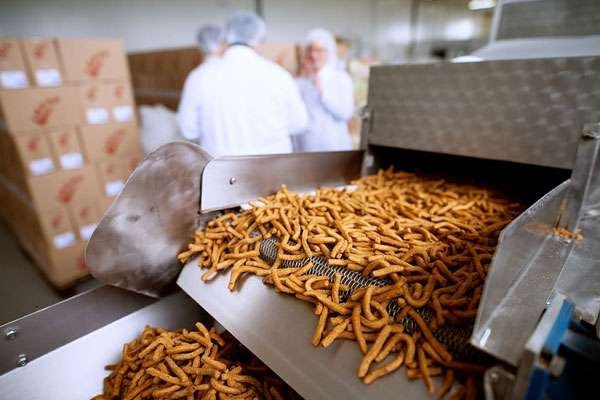
Snack Manufacturing
Used in selected potato-based and processed snack formulations.

Bakery
Products
Can be incorporated into selected bakery formulations where potato ingredients are required.
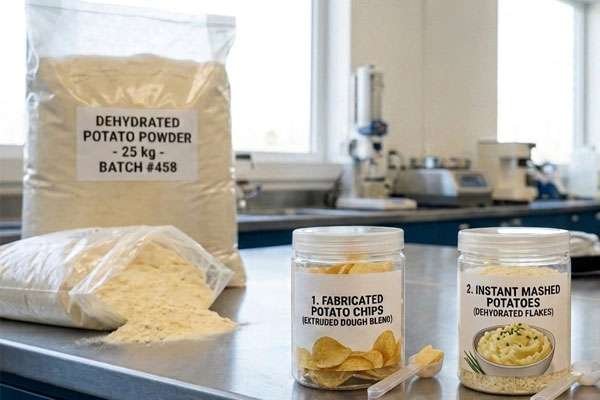
Instant Food Products
Useful for convenient and dry food formulations.
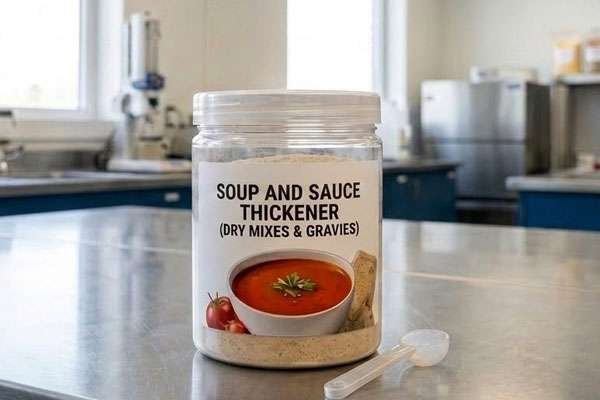
Soups and
Sauces
Can contribute potato characteristics and body to selected formulations.

Ready-to-Eat
Foods
Potato powder can be used in various prepared and convenience food formulations.
The appropriate powder specification depends on the application and formulation requirements.
Potato Powder vs Potato Flakes
Potato powder and potato flakes are related but different forms of dehydrated potato.
Potato Flakes
Generally produced by drying cooked potato mash into a thin sheet and breaking it into flakes.
Potato Powder
Requires further size reduction to produce a finer powdered material.
Therefore, a manufacturer interested in both products may consider a flexible production configuration that allows dried potato material to be processed into different final forms.
This can provide greater product flexibility and market opportunities.
Why Choose Bharat Industrial Machinery?
Bharat Industrial Machinery provides industrial food-processing machinery and production-line solutions for manufacturers looking to establish or expand their processing operations.
For a Potato Powder Production Plant, equipment selection can be considered according to:
- Required capacity
- Raw potato characteristics
- Product specification
- Powder fineness
- Automation level
- Factory layout
- Packaging requirements
- Utility availability
The objective is not simply to supply a Potato Powder Making Machine, but to develop a practical equipment configuration that supports the complete production process.
For manufacturers planning a new plant, a detailed discussion about raw-material input, target output, product specification and automation requirements is the best starting point.
Conclusion
A successful Potato Powder Production Plant is not defined by one large machine. It is defined by how efficiently the entire process works together.
From raw-potato cleaning and peeling to cooking, drying, grinding, sieving and packaging, every stage has an influence on production efficiency, yield and finished-product consistency.
The right Potato Powder Making Machine must therefore be selected according to the required particle size, capacity, raw material and final application.
For manufacturers planning a commercial Potato Powder Manufacturing Plant, the best investment strategy is to begin with the product specification and production target, then engineer the complete line around those requirements.